Tea for Perimenopause Symptoms: What the Botanicals Actually Do
Half the world will experience menopause, and most will endure years of unpleasant symptoms and discomfort. The medical options are few and not for everyone, and most of what fills the space around them is marketing. Plants sit somewhere in between: traditionally used to steady these symptoms across many centuries and most cultures, and in a few cases now examined properly. What follows is a careful account: what perimenopause actually is, what the botanicals in a morning and evening blend are understood to do, what the human evidence supports, and how to use a cup so that it earns its place in the day.
What perimenopause actually is
Perimenopause is the transition leading up to the final period, not the event itself. It commonly begins in a woman's forties and can run anywhere from a few years to a decade. Menopause is diagnosed retrospectively, twelve months after the last period, which means most of the experience people describe as menopause is in fact this earlier stretch.
Oestrogen does not fall away in a smooth line. Through perimenopause it fluctuates, sometimes rising well above premenopausal levels before dropping sharply, and it is the volatility rather than the eventual low that produces most of what people notice: hot flushes and night sweats, mood that moves faster than it used to, sleep that fractures at three in the morning, energy that arrives and leaves without much warning. Hot flushes and night sweats are reported by roughly four in five women during this transition.
The good news, nature has some options...

Sage
Salvia officinalis has the most direct evidence of anything in this category, and has been used traditionally for excessive sweating for centuries. In an open multicentre trial, 69 menopausal women took a daily tablet of fresh sage leaf extract for eight weeks and reported a substantial reduction in the frequency and intensity of hot flushes. A later double-blind, placebo-controlled trial in 80 women found improvement in menopause rating and hot flush severity scores over four weeks.
Red clover
Trifolium pratense is the phytoestrogen of the group. Its isoflavones resemble oestradiol closely enough to bind oestrogen receptors, with a preference for the beta receptor. A 2021 meta-analysis of eight trials found roughly 1.7 fewer hot flushes per day compared with placebo. An earlier review found a difference in the same direction that did not quite reach significance, with very high variation between studies. The fair summary is that the effect is real yet modest.
Lemon balm
Melissa officinalis has been used for restlessness and nervous tension since at least the Middle Ages, and its rosmarinic acid is thought to inhibit the breakdown of GABA, which points toward gentle downward pressure on nervous system arousal rather than anything decisive. A randomised double-blind trial of sixty postmenopausal women with sleep disturbance found improvement across menopause-specific quality-of-life domains over eight weeks. It was small, single-centre, and the preparation combined lemon balm with fennel, so it is suggestive rather than settled.
Its more immediate contribution is aromatic. Lemon balm lifts the dry, savoury edge sage brings, which is why it sits in the morning blend rather than the evening one.
Nettle leaf
Nettle is in the morning blend for its mineral content, iron and magnesium and potassium among them, and for the green, hay-sweet body it gives underneath the sage. There is no trial evidence for nettle in perimenopause specifically. It would be easy and untrue to imply otherwise.
Chamomile
Chamomile is the most studied of the evening botanicals. Its calming effect is generally attributed to apigenin, a flavonoid that appears to bind benzodiazepine receptors and modulate GABA activity. The human research shows real but modest improvements in self-reported sleep quality and in generalised anxiety, often in people already sleeping poorly. What it does not show is a sedative effect comparable to medication. Chamomile does not switch the nervous system off. It lowers the temperature of it slightly.
Lavender
Trials in postmenopausal women with insomnia have found improvements in sleep quality, and in one case in self-reported hot flushes, from nightly inhalation. A hot cup does deliver aroma, and there is a reasonable argument that part of the effect carries across.
Passionflower
Passiflora incarnata has been examined in a handful of small human trials, some finding modest improvements in sleep quality over placebo across short periods.
The ones that are there for the cup
Ginger, cinnamon, rose petals and calendula. Ginger is well studied for nausea; here it gives warmth and a circulatory lift that keeps the morning blend drinkable rather than medicinal. Cinnamon has been studied for blood sugar; it is in the evening cup for sweetness without sugar. Rose and calendula contribute colour and a soft floral finish.
Caffeine & Menopause
Caffeine has a half-life of roughly five to six hours in most adults, so a coffee at four in the afternoon leaves a meaningful dose still circulating at ten at night. Perimenopausal sleep is already being interrupted from the inside, by night sweats and early waking, and caffeine narrows a margin that is thin to begin with.
There is also some evidence pointing at the flushes themselves. The largest survey on the question, covering 1,806 women attending a menopause clinic, found that caffeine users reported more bothersome hot flushes and night sweats than non-users.
Worth restating plainly, because it is the most common error in tea writing: green tea, white tea, oolong and matcha are all caffeinated. If the leaf comes from Camellia sinensis, it has caffeine in it. Only true tisanes are caffeine-free. We have made the fuller version of this argument in Tea and Sleep: What the Botanicals Actually Do.

The benefit of a wind-down cue
Perimenopause is unusual among health subjects in that it is long and largely unmanaged. It is measured in years rather than weeks, and a good deal of it is spent noticing that something has shifted without much to do about it on any given Tuesday.
Two fixed points in the day are worth more here than they sound. A pot made at breakfast and another after dinner are small, repeatable and entirely within your control, in a period where a fair amount is not. The evening one doubles as what sleep researchers call a wind-down cue, and the behavioural literature is unusually clear that consistency matters.
How to use it

Drink RISE with breakfast. Sage is the reason to take this blend early, and the cup is warming without being stimulating in the way coffee is. It also anchors the front of the day, which is where most people's routine is already most reliable.
Drink SETTLE after dinner, about ninety minutes before bed. Late enough to work as a closing signal, early enough that the fluid does not wake you at three. That second consideration matters more than usual when sleep is already fragile; if night waking is the problem, move it earlier and make the pot smaller rather than skipping it.

Brew both properly. One teaspoon to a 200mL cup, water at a full 100°C, five to seven minutes. Herbal botanicals need boiling water and a longer steep than green or white tea to give up their aromatics; the common instinct to treat them gently is misplaced. Infuse once only.
Give it a season, not a fortnight. The trials that found anything ran for four to twelve weeks. Perimenopausal symptoms also fluctuate on their own, week to week, for reasons that have nothing to do with what you drink, which means a short trial tells you almost nothing either way.
Keep a short note. Flushes, sleep, mood, three lines a day. It is the only reliable way to tell whether a change is real or whether you have simply had a better fortnight.
What it will not do
These blends are not hormone therapy and not a treatment for perimenopause. If symptoms are disrupting work, relationships or sleep, hormone therapy and non-hormonal prescription options both exist and are worth a conversation with a doctor rather than a change of beverage. Perimenopause is also a diagnosis worth having made properly: heavy bleeding, bleeding between periods, or any bleeding after twelve months without a period should be investigated rather than attributed.
A few cautions are specific enough to be worth naming.
Chamomile and calendula are both members of the Asteraceae family, so anyone with a known allergy to ragweed, daisies or chrysanthemums should approach with care.
Passionflower and lemon balm may compound the effects of sedatives and some anti-anxiety medications. Chamomile may interact with anticoagulants.
If you are taking regular medication, ask your doctor before making any herbal infusion a daily habit. Different people respond differently to herbs.
The blend
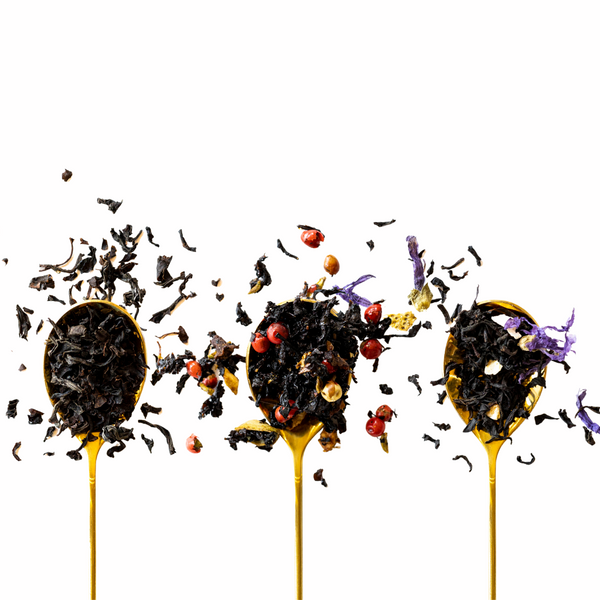
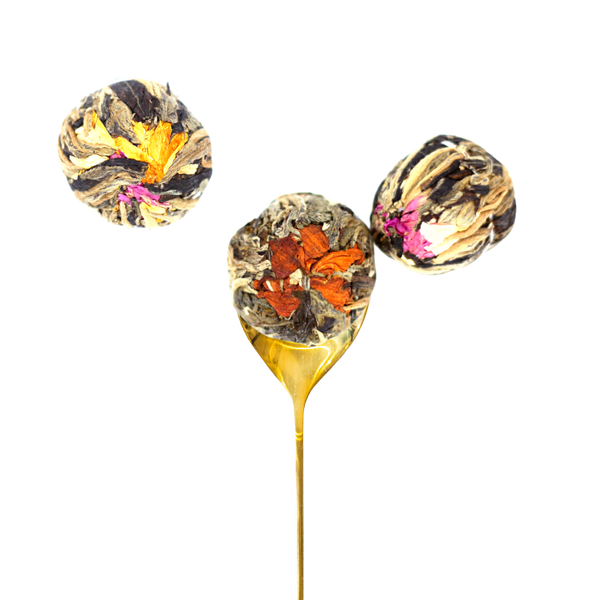
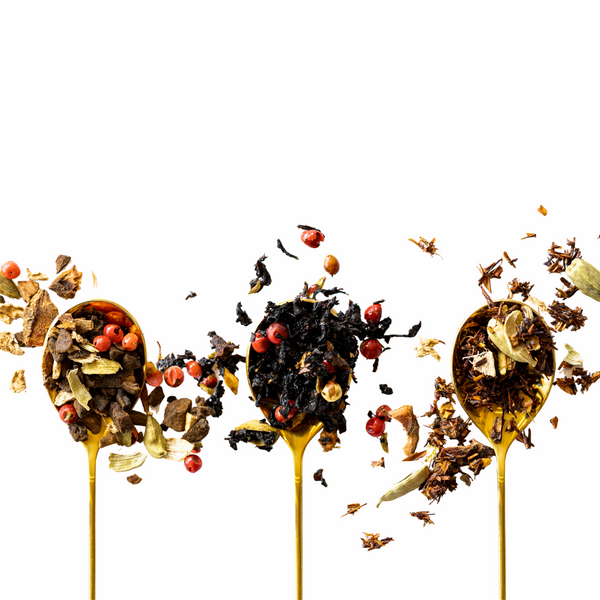
Our Perimenopause Tea is two blends made to be drunk at opposite ends of the day. RISE is built on sage with nettle, ginger, lemon balm, red clover and rose: dry and faintly savoury, lifted by the ginger, green underneath, floral on the finish. SETTLE is lavender-forward over a chamomile base with passionflower, cinnamon and calendula: softer, sweeter, warm at the back of the cup. Both organic, both caffeine-free, no synthetic flavouring.
Neither is hormone therapy. They are two well-made, honest things to hold at either end of a day, through a transition that is measured in years rather than weeks, and used consistently that turns out to matter more than most people expect.
Brew guide: 1 tsp to 200mL, 100°C, 5–7 minutes, infuse once.
If broken sleep is the sharper problem, our Sleeptime Tea is built for that specifically, and the fuller account of the evening botanicals is in Tea and Sleep.
Sources
- Bommer S, Klein P, Suter A. First time proof of sage's tolerability and efficacy in menopausal women with hot flushes. Advances in Therapy. 2011;28(6):490–500. doi:10.1007/s12325-011-0027-z
- Dimpfel W, Chiegoua Dipah GN, Bommer S. Effectiveness of Menosan Salvia officinalis in the treatment of a wide spectrum of menopausal complaints. A double-blind, randomized, placebo-controlled clinical trial. Heliyon. 2021;7(2):e05910.
- Kanadys W, et al. Evaluation of clinical meaningfulness of red clover (Trifolium pratense L.) extract to relieve hot flushes and menopausal symptoms in peri- and post-menopausal women: a systematic review and meta-analysis of randomized controlled trials. 2021. PMID:33920485
- Ghazanfarpour M, et al. Red clover for treatment of hot flashes and menopausal symptoms: a systematic review and meta-analysis. Journal of Obstetrics and Gynaecology. 2016;36(3):301–311. doi:10.3109/01443615.2015.1049249
- Shirazi M, Jalalian MN, Abed M, Ghaemi M. The effectiveness of Melissa officinalis L. versus citalopram on quality of life of menopausal women with sleep disorder: a randomized double-blind clinical trial. Revista Brasileira de Ginecologia e Obstetricia. 2021;43(2):126–130. doi:10.1055/s-0040-1721857
- Lucena L, et al. Effect of a lavender essential oil and sleep hygiene protocol on insomnia in postmenopausal women: a pilot randomized clinical trial. Explore (NY). 2024;20(1):116–125. doi:10.1016/j.explore.2023.07.004
- Faubion SS, Sood R, Thielen JM, Shuster LT. Caffeine and menopausal symptoms: what is the association? Menopause. 2015;22(2):155–158. doi:10.1097/GME.0000000000000301
Written by Sarah de Witt